
SEO can feel complicated when you are new to it.
Keywords. Content. Technical fixes. Backlinks. Google updates. AI search results.
However, the core idea is simple: SEO helps the right people find the right page when they search for something you can genuinely help with.
I’m Muhammad Daniyal, Founder and Lead SEO Strategist at Lyf Tech. I have worked on SEO for service businesses, growing websites, and content-led brands. The approach that works is rarely a shortcut. It is a clear system built around useful pages, sound website structure, and consistent improvement.
This guide explains how SEO works, what matters most in 2026, and what I would do first if I were starting a website from zero.
What Is SEO?
SEO stands for search engine optimization.
It is the process of improving your website so search engines can understand your pages and show them to people searching for relevant information, products, or services.
For example, a plumber in Dallas may want to appear for searches such as:
- “emergency plumber in Dallas”
- “burst pipe repair near me”
- “water heater repair Dallas”
A useful SEO strategy would include clear service pages, local relevance, strong technical foundations, helpful supporting content, and trustworthy business signals.
SEO is not simply adding a keyword to a page several times.
Good SEO is about matching search intent, explaining a topic clearly, making your pages easy to crawl, and giving people a reason to trust your business.
Google describes SEO as helping search engines understand your content while helping users find your site and decide whether it is useful for their search. Google’s SEO Starter Guide is a good reference for the fundamentals.
Why SEO Matters for Businesses
Search traffic is valuable because it often comes from people actively looking for an answer, service, or product.
Someone searching “how does SEO work” wants to learn.
Someone searching “SEO agency for small business” may be comparing providers.
Someone searching “local SEO services near me” is likely much closer to taking action.
These are different searches with different intent. A strong SEO strategy creates the right page for each one.
SEO can help your business:
- Reach people when they are already looking for what you offer
- Build awareness before a buyer is ready to contact you
- Generate leads from service pages and educational content
- Reduce reliance on paid traffic over time
- Build a content asset that can keep attracting relevant visitors
I often explain it this way: paid ads rent attention, while SEO builds an owned marketing asset.
That does not mean SEO replaces paid ads. Google Ads can bring immediate visibility, while SEO takes time to build. In many cases, the strongest approach is to use both channels for different goals.
I explain this in more detail in my guide on SEO vs. Google Ads for long-term business growth.
How Search Engines Work
You do not need to become a search engineer to do SEO well.
However, you should understand the three main stages of how search engines handle your pages: crawling, indexing, and ranking.
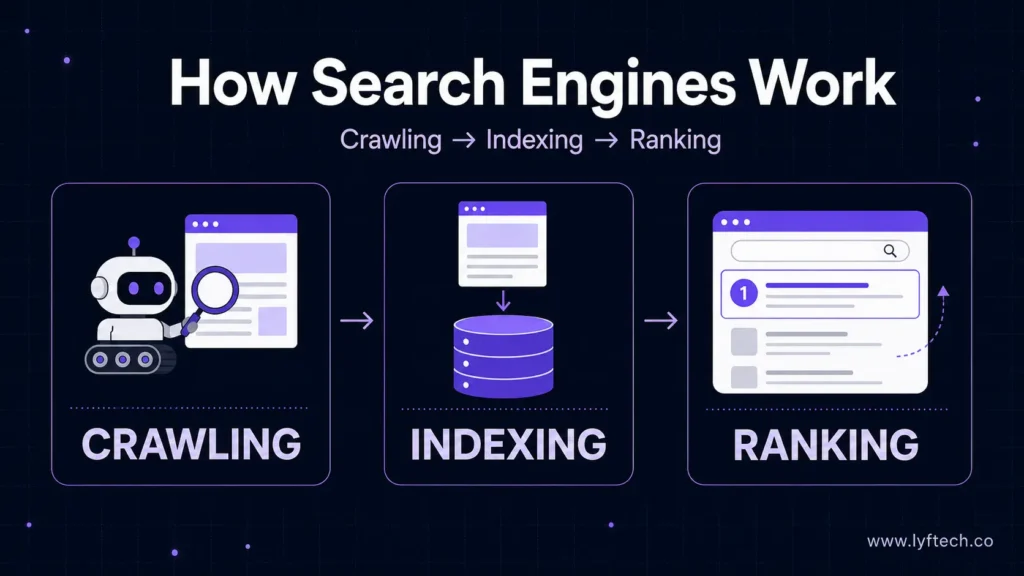
1. Crawling: Search Engines Discover Your Pages
Search engines use automated programs, often called crawlers or bots, to discover pages across the web.
They usually find pages through links, XML sitemaps, and existing URLs they already know about.
A well-structured website makes this easier. Your important pages should be linked from relevant pages on your site. They should not be hidden behind broken links, blocked by technical settings, or disconnected from the rest of your content.
For example, if you publish a useful article but no other page links to it, Google may still find it. But you are making discovery and context harder than necessary.
2. Indexing: Search Engines Decide Whether to Store the Page
After a search engine crawls a page, it tries to understand what the page is about and whether it can be included in its index.
If a page is blocked by a noindex tag, has duplicate-content problems, returns an error, or provides very little useful information, it may not be indexed properly.
An indexed page is eligible to appear in search results. A page that is not indexed cannot rank.
Google’s crawling and indexing documentation explains how robots directives, sitemaps, canonical tags, and technical accessibility affect this process.
3. Ranking: Search Engines Choose the Best Result
When someone searches, Google evaluates eligible pages and decides which results are likely to help that person most.
There is no single “SEO score” that decides rankings.
Search results are influenced by many systems and signals, including relevance to the query, content usefulness, search intent, technical accessibility, links, location where relevant, and the overall quality of the page.
The practical takeaway is simple: create a page that deserves to be the result.
A Simple Way to Think About SEO
I use a library analogy when explaining SEO to beginners.
Think of Google as a massive library.
- Crawling is the librarian discovering a new book.
- Indexing is the librarian adding that book to the collection.
- Ranking is the librarian recommending the best book when someone asks a question.
If your content is hard to find, unclear, outdated, or poorly organized, it is less likely to be recommended.
The Five Core Parts of SEO
SEO works best when you treat it as a connected system rather than a random list of tasks.
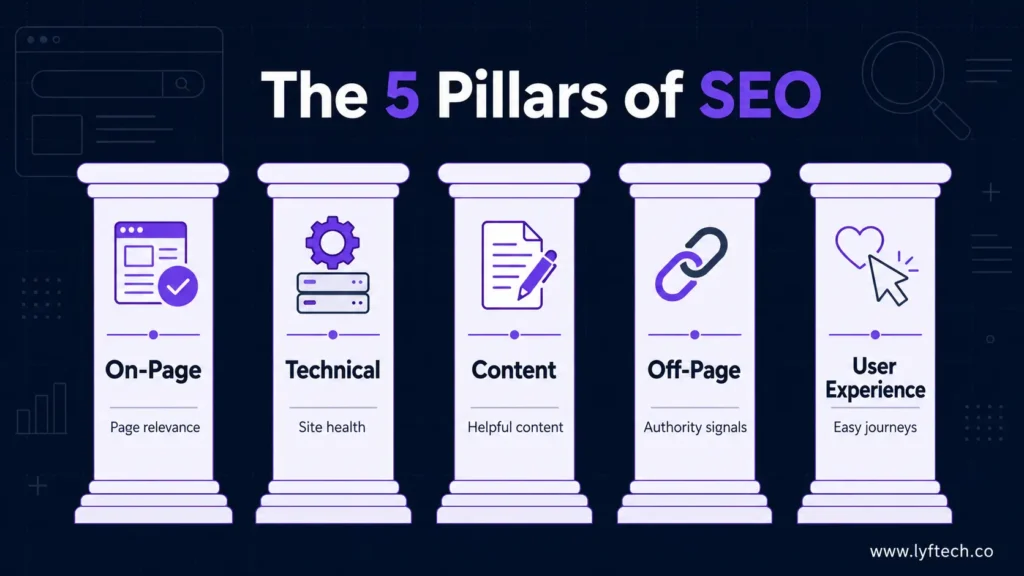
1. On-Page SEO
On-page SEO is the work you do directly on a page to make it clear, useful, and relevant.
This includes:
- Title tags and meta descriptions
- Headings and page structure
- Search-intent alignment
- Clear URL structure
- Natural keyword use
- Internal links
- Image alt text
- Readability and content formatting
This is where many websites can improve quickly because the fixes are visible and practical.
Read my full on-page SEO guide for a deeper breakdown.
2. Technical SEO
Technical SEO is the website foundation that helps search engines crawl, render, and index your pages correctly.
It includes:
- Website speed and Core Web Vitals
- Mobile usability
- XML sitemaps
- Robots.txt rules
- Canonical tags
- Redirects
- HTTPS
- Crawl errors
- Structured data
- Broken links and server errors
Technical SEO cannot make weak content great. But technical problems can hold back a genuinely useful page.
If you want a full framework, read my technical SEO guide.
3. Content SEO
Content SEO is the process of creating pages that answer real questions and support the topics your audience cares about.
This includes guides, service pages, comparisons, checklists, tutorials, and topic clusters.
For example, a plumber should not only have a page for emergency plumbing. They can also publish helpful resources such as:
- What to do when a pipe bursts
- Signs you need water-heater repair
- How much drain cleaning costs
- How to prevent frozen pipes
This content helps people before they are ready to call. It also supports the main commercial pages through relevant internal links.
4. Off-Page SEO
Off-page SEO refers to trust signals that come from beyond your own website.
Backlinks are the best-known example. When a relevant, reputable website links to a useful page on your site, it can support your authority and visibility.
The quality and relevance of a link matter more than raw volume.
A few links from trusted sites in your industry can be more useful than hundreds of low-quality directory or spam links.
Learn how to approach this properly in my link-building guide.
5. User Experience
A visitor should be able to use your website easily on any device.
That means pages should be readable, mobile-friendly, fast enough to use comfortably, and free from frustrating layout shifts or intrusive elements.
Good user experience is not about chasing a vague ranking trick. It is about making sure the person who reaches your website can find what they need and take the next step.
The SEO Factors That Matter Most
You do not need to obsess over hundreds of supposed ranking factors.
Focus on the things that make a real difference.
Search Intent
Search intent is the reason behind a search.
Before creating a page, search the target keyword and look at what already ranks.
Does the search result show:
- Informational guides?
- Product or category pages?
- Local businesses?
- Comparison articles?
- Videos?
- Tools or calculators?
A page can be well written and still struggle if it is the wrong format for the query.
For example:
- “What is SEO?” needs an educational guide.
- “Best SEO tools” needs a comparison or list.
- “SEO services for dentists” needs a focused service page.
- “SEO audit checklist” may need a checklist, template, or detailed guide.
Content That Actually Helps
Google does not need another page that repeats basic information without adding anything useful.
The strongest content answers the main question clearly, covers related questions naturally, gives examples, and helps the reader make a decision or take action.
Do not write longer just to hit a word count.
Write enough to satisfy the search properly.
Topical Coverage
Topical authority is not a single Google metric. It is a practical way to think about becoming a credible resource on a subject.
One article about SEO is not enough to show depth.
A well-connected group of guides covering SEO strategy, technical SEO, on-page SEO, content, local SEO, audits, and link building gives both users and search engines much stronger context.
This is why I recommend building topic clusters instead of publishing unrelated blog posts. Read my guide on topical authority to see how this works.
Internal Linking
Internal links help search engines discover pages and understand how your content connects.
They also help readers move from a broad topic to the next useful page.
For example, this SEO starter guide links to more detailed resources on technical SEO, on-page SEO, SEO audits, and content strategy. That is useful for the reader and creates a clear topic structure across the site.
Use descriptive anchor text. Avoid vague links such as “click here.”
Relevant Backlinks and Brand Trust
Links from trusted, relevant websites can support your authority, especially in competitive markets.
However, link building should not be treated as buying random placements or collecting links for the sake of it.
Build useful pages first. Then promote those pages, build relationships, contribute expert insights, and earn links that make sense for your audience.
Technical Health
Your website should allow search engines to access important pages without issues.
At a minimum, make sure you have:
- An XML sitemap
- Important pages indexed
- Mobile-friendly templates
- No major broken links or crawl errors
- HTTPS enabled
- Clear internal links
- Fast and stable page templates
- Proper redirects for moved pages
Types of SEO
SEO changes depending on the type of business and website you run.
Local SEO
Local SEO helps businesses appear in location-based searches and map results.
It is important for dentists, clinics, plumbers, lawyers, real estate businesses, restaurants, and other location-based services.
The main areas include Google Business Profile optimization, local landing pages, reviews, location relevance, local citations, and service-area targeting.
Read my local SEO guide to learn more.
Ecommerce SEO
Ecommerce SEO focuses on category pages, product pages, internal linking, filters, product information, structured data, and purchase-intent keywords.
It requires strong site architecture because ecommerce sites often have many URLs and duplicate-content risks.
Content SEO
Content SEO focuses on guides, blogs, tutorials, comparisons, templates, and other pages built around search demand.
It is how many brands build awareness, topic depth, and long-term organic traffic.
Technical SEO
Technical SEO focuses on the website’s infrastructure and search accessibility.
This becomes especially important for larger sites, sites with many pages, ecommerce stores, JavaScript-heavy websites, and websites that have gone through redesigns or migrations.
A Beginner SEO Roadmap
This is the order I recommend for a new website or business.
Step 1: Understand Your Audience
Start with the people you want to reach.
Ask:
- What problem are they trying to solve?
- What services or products are they looking for?
- What questions do they ask before buying?
- Are they searching locally, nationally, or globally?
- What would make them trust a business like yours?
If you do not understand the audience, keyword research alone will not give you a strong strategy.
Step 2: Research Search Intent and Keywords
Find the phrases your audience uses, then study the search results for those terms.
Start with realistic targets.
A new website should not expect to rank quickly for a huge, competitive term such as “SEO.” A better starting point may be a specific, lower-competition topic with a clear audience need.
Long-tail keywords are often more specific and more commercially useful.
Step 3: Build Your Most Important Pages First
For a service business, start with:
- Homepage
- Core service pages
- Location pages where genuinely relevant
- About and trust pages
- Contact page
- Case studies or proof pages
For a content-led website, start with your most important pillar guides.
Do not publish 30 random blog posts while your main commercial pages are weak or unclear.
Step 4: Improve Your On-Page SEO
For every important page, check:
- Does the title accurately describe the page?
- Does the H1 match the search intent?
- Is the introduction clear?
- Are the headings easy to scan?
- Is the page genuinely useful?
- Are internal links included naturally?
- Is there a clear next step for the reader?
Step 5: Fix the Technical Basics
Set up Google Search Console and Google Analytics.
Then check whether your pages are indexed, whether the site works properly on mobile, and whether major technical issues are blocking performance.
My SEO audit guide explains what I check when reviewing a website.
Step 6: Publish Helpful Supporting Content
Create content that answers the questions people ask before they become customers.
Each article should have a clear purpose. It should support a relevant service, product, or pillar page where appropriate.
This is where a clear SEO strategy matters. A documented plan is far more effective than publishing whenever you feel like it.
Step 7: Build Internal Links Intentionally
Every useful page should connect to other relevant pages.
Your pillar pages should link to supporting articles. Supporting articles should link back to the pillar or commercial page where it helps the reader.
This creates a website that feels connected rather than scattered.
Step 8: Measure, Improve, and Refresh
SEO is never completely finished.
Use Google Search Console to monitor impressions, clicks, queries, indexing issues, and page-level performance.
Then improve what you learn:
- Refresh pages losing visibility
- Expand articles that are close to ranking well
- Fix technical problems
- Add missing internal links
- Create supporting content around successful topics
- Improve pages that get traffic but do not convert
SEO From Zero Checklist
A practical checklist for building a website that can earn relevant traffic, leads, and long-term visibility.
Common SEO Mistakes Beginners Make
Targeting Keywords That Are Too Competitive
Start with focused topics where you have a realistic chance to compete.
Build trust and coverage before chasing the biggest keywords in your niche.
Ignoring Search Intent
A sales page will not satisfy every informational query.
A 3,000-word guide will not satisfy every local service query.
Match the page format to what people are trying to do.
Publishing Thin Content
A short article is not automatically bad.
But a page that gives generic advice, adds no experience, and leaves the reader with more questions than answers is unlikely to perform well over time.
Keyword Stuffing
Use your main keyword naturally in the title, introduction, headings where appropriate, and body copy.
Then write for clarity.
Search engines understand related terms and context. Repeating the same phrase in every sentence makes the page worse.
Treating Internal Links as an Afterthought
Do not publish content and leave it isolated.
Connect every article to the pages that provide the next useful step.
Ignoring Technical Problems
Content cannot fully compensate for inaccessible pages, broken links, poor mobile usability, slow templates, or indexing issues.
Expecting Results in a Few Weeks
SEO is a long-term channel.
Some technical fixes can show an impact quickly. Most meaningful content and authority gains take longer.
SEO Tools Worth Using
You do not need to pay for every SEO tool available.
Start with the basics.
Google Search Console
Google Search Console shows how your site appears in Google Search.
You can use it to review:
- Search queries
- Impressions and clicks
- Top-performing pages
- Indexing status
- Crawl and page-experience issues
- Sitemap submission
It is the first tool I recommend setting up on any website.
Google Analytics
Google Analytics helps you understand what visitors do after they arrive.
Use it to track organic traffic, engagement, conversions, important landing pages, and the path people take before they submit a form or contact you.
Keyword Research Tools
Tools such as Ahrefs, Semrush, Keyword Planner, and similar platforms can help you find keywords, related topics, and competitor opportunities.
Use them to support your judgment, not replace it.
Technical Audit Tools
A crawler such as Screaming Frog can help you find broken links, redirects, duplicate titles, missing metadata, indexability issues, and other technical problems that are easy to miss manually.
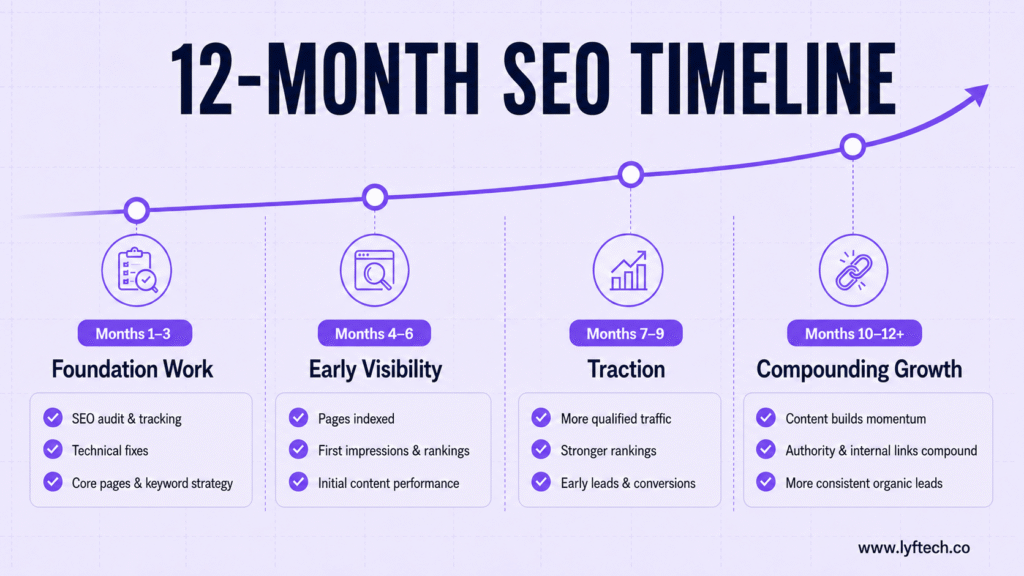
How Long Does SEO Take?
The honest answer is that it depends.
SEO timelines vary based on your existing authority, competition, technical health, website quality, content depth, and consistency.
A realistic general timeline looks like this:
| Timeframe | What usually happens |
| Months 1–2 | Research, technical fixes, tracking setup, and core-page improvements |
| Months 3–4 | Early indexing, visibility growth, and initial ranking movement |
| Months 5–6 | More consistent impressions, stronger page performance, and early lead opportunities |
| Months 6–12+ | Compounding results from content, internal links, authority, and ongoing improvements |
Google itself notes that changes can take from hours to several months to be reflected in Search. Give meaningful work enough time before judging the result.
For a fuller explanation, read my guide on how long SEO takes.
Where SEO Is Headed
Search is changing.
AI-generated answers, richer result formats, videos, shopping results, map packs, and more direct answers are changing how people discover information.
However, the foundation remains the same.
Create pages that are useful, accurate, accessible, well structured, and worth trusting.
Do not build your strategy around chasing one feature in Google’s results. Build a website with real expertise, clear information, and content that supports your audience at every stage of their journey.
That is the kind of SEO work that holds up over time.
Summary
SEO is not about gaming an algorithm.
It is about building a website that search engines can understand and people genuinely want to use.
Start with your audience. Match search intent. Build strong core pages. Fix technical issues. Publish useful content. Link your pages with purpose. Track the data. Then keep improving.
That is how organic growth becomes more predictable.
At Lyf Tech, we help businesses build practical SEO systems through strategy, content, technical improvements, and internal linking.
If you want to know what is holding your website back, request a free SEO audit. I will review the biggest technical, content, and visibility opportunities on your site.
You can also learn more about our SEO services.
Frequently Asked Questions
What is SEO in simple words?
SEO is the process of improving your website so it can appear in relevant search results and attract people who are looking for your information, services, or products.
How do search engines work?
Search engines discover pages through crawling, decide which pages to store through indexing, and choose which pages to show through ranking.
Is SEO difficult for beginners?
The basics are learnable. Start with search intent, useful content, on-page optimization, technical foundations, and internal linking. Real experience comes from applying these skills to actual websites.
How long does SEO take to work?
Most websites need several months to build meaningful momentum. The timeline depends on competition, technical health, content quality, authority, and how consistently you improve the site.
Is SEO better than paid ads?
They serve different purposes. Paid ads can bring fast visibility, while SEO can build long-term organic traffic. Many businesses benefit from using both strategically.
Do small businesses need SEO?
Yes. SEO can help small businesses reach local and niche audiences without needing to match a larger competitor’s advertising budget.
What should I do first when starting SEO?
Understand your audience and their search intent. Then research realistic keywords, improve your key pages, set up tracking, fix technical basics, and publish helpful content consistently.
Written by Muhammad Daniyal, Founder and Lead SEO Strategist at Lyf Tech. Last reviewed: July 2026.