

SEO statistics are only useful when they change what you do next.
That is why I have not collected random numbers just to make this page look impressive. I selected 90+ statistics that help business owners, marketers, and SEO teams make better decisions about search visibility, content, technical work, local trust, and AI-driven discovery.
I checked the publisher pages behind the data and linked to them throughout this guide. Some studies were published before 2026 because they remain the latest available research for that metric. I have labelled those figures as study findings, not universal rules.
Quick Takeaways
Here is what stands out to me most:
- Google is still the main search engine for most markets, so Google-first SEO is still the practical starting point.
- Search traffic and clicks are heavily concentrated near the top of the results.
- Most pages never earn meaningful organic traffic, which is why publishing without an intent-led plan is expensive.
- Technical issues are still common, especially weak internal linking, redirects, and slow pages.
- Local buyers pay close attention to rating, review quantity, and review recency.
- AI search is changing discovery, but it has not created a separate set of secret SEO rules. Helpful, crawlable, well-structured pages still matter.
For the wider foundation, start with my SEO starter guide.
Search Engine Market Share Statistics
The figures below are worldwide market share figures for July 2026 from StatCounter. Market share changes month to month, so treat this section as a snapshot rather than a permanent benchmark.
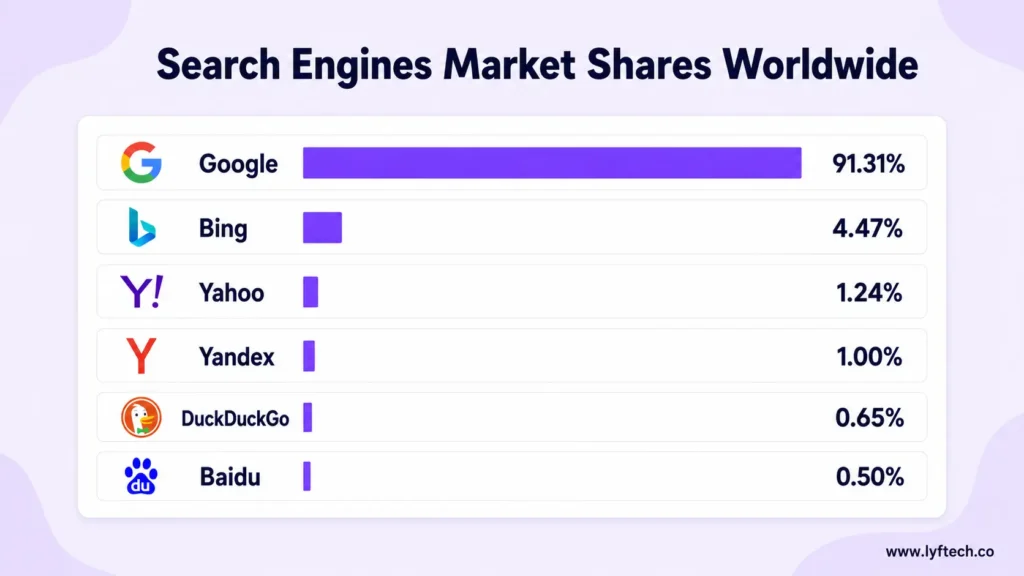
- Google held 91.31% of worldwide search-engine market share.
- Bing held 4.47%.
- Yahoo! held 1.24%.
- Yandex held 1.00%.
- DuckDuckGo held 0.65%.
- Baidu held 0.50%.
What this means for your SEO strategy
For most businesses, Google remains the primary place to earn search visibility. That does not mean you should ignore Bing, YouTube, Reddit, Amazon, social platforms, or AI tools when they matter to your customers.
It means your website should first meet the standards Google needs to crawl, understand, and rank it. Google says its search process is automated, moving through crawling, indexing, and serving results. It also makes clear that it does not guarantee crawling, indexing, or ranking for any page. Google’s guide to how Search works is worth reading if you want the fundamentals without myths.
Organic Search Traffic and Ranking Statistics
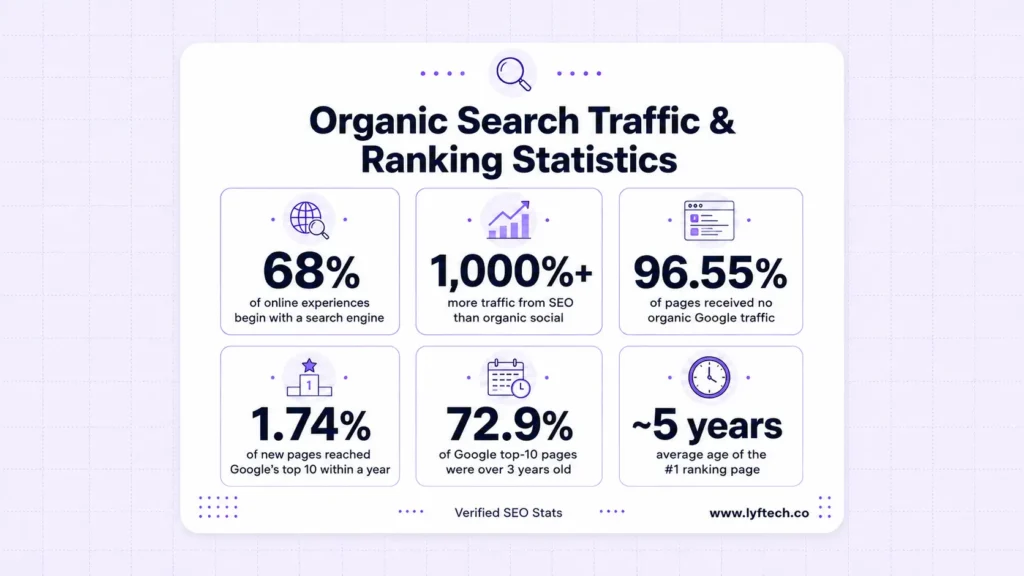
- 68% of online experiences begin with a search engine, according to BrightEdge data cited by Ahrefs.
- Google accounted for 63.41% of US web-traffic referrals in SparkToro’s analysis cited by Ahrefs.
- SEO drives more than 1,000% more traffic than organic social media, according to BrightEdge data cited by Ahrefs.
- 96.55% of pages in Ahrefs’ index received no organic Google traffic in its 2023 study.
- Only 1.94% of pages in that study received between one and ten monthly Google visits.
- The top-ranking page was also the page with the most total search traffic only 49% of the time.
- Only 1.74% of newly published pages reached Google’s top 10 within a year for at least one keyword in Ahrefs’ 2025 analysis.
- Of the pages that did reach the top 10 within a year, 40.82% did so within the first month.
- 72.9% of pages ranking in Google’s top 10 were more than three years old.
- The average number-one ranking page was about five years old.
- Only 13.7% of pages in Google’s top 10 were under one year old.
Sources: Ahrefs’ 2026 SEO statistics roundup, Ahrefs’ search traffic study, and Ahrefs’ page-age study.
What these statistics actually tell me
SEO is not a publishing-volume contest.
Most pages fail because they are created without enough demand, a clear search intent, a real point of difference, or links from the rest of the site. The answer is not to make every page 3,000 words long. It is to create the right page for a real audience question, then give it the support needed to compete.
I have also seen new websites gain relevant traffic sooner than expected when they target narrow, commercially useful topics and have a strong website foundation. But it is irresponsible to promise a fixed ranking timeline. Results depend on the query, competition, website history, quality of the page, internal links, external authority, and the business itself.
If you are starting from zero, my SEO audit guide explains the checks I would prioritise before producing a large content batch.
Google CTR and Click Distribution Statistics
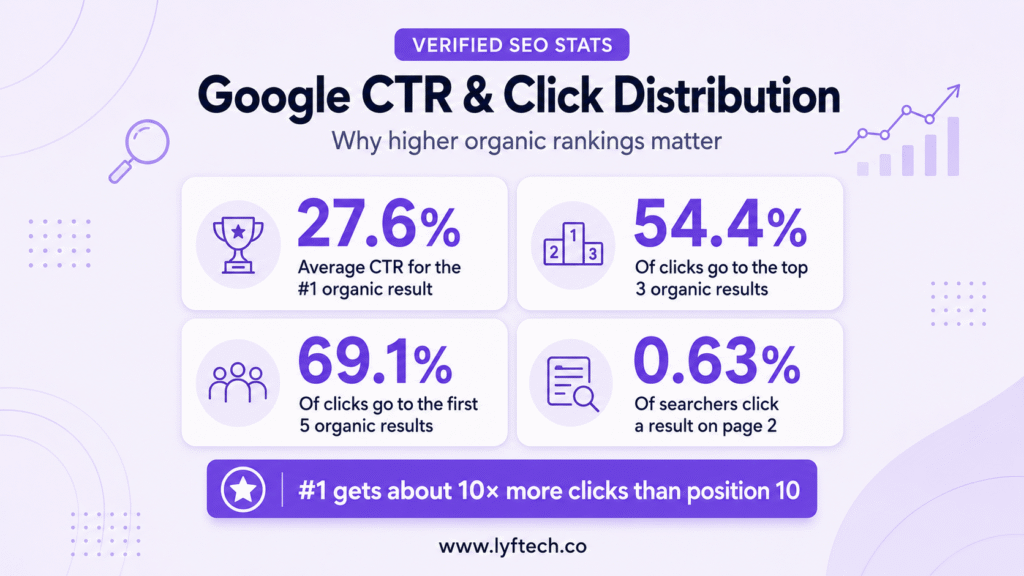
- The number-one organic result receives an average click-through rate of 27.6% in Backlinko’s analysis of four million Google search results.
- The top three organic results receive 54.4% of all clicks in that dataset.
- The first five organic results receive 69.1% of clicks in Up Inc. data cited by Backlinko.
- Only 0.63% of Google searchers click a result on the second page, according to Backlinko’s study.
- The number-one result receives about 10 times more clicks than the result in position 10.
- Moving up one position increased relative CTR by 32.3% on average in Backlinko’s dataset.
- That same movement increased absolute CTR by 2.8 percentage points on average.
- Moving from position two to position one produced a relative CTR increase of 74.5% in the study.
- 96.98% of desktop clicks in Ahrefs’ August 2025 US sample happened within the top 10 results.
- 97.56% of mobile clicks in that sample happened within the top 10 results.
Sources: Backlinko’s Google CTR study, Backlinko’s 2026 SEO statistics roundup, and Ahrefs’ click-distribution study.
My takeaway on CTR
Page-one visibility is only a milestone. The commercial value often changes much more when a priority page moves from position six to position two, or from position two to position one.
That is why I review the pages already sitting close to the top before chasing new keywords. Improve the intent match, answer the main question earlier, add missing proof, strengthen internal links, and write a title that accurately tells the searcher why the page is worth opening.
Do not chase clicks by making titles misleading. A high CTR with poor engagement is not a win.
Content, Backlinks and Ranking Statistics
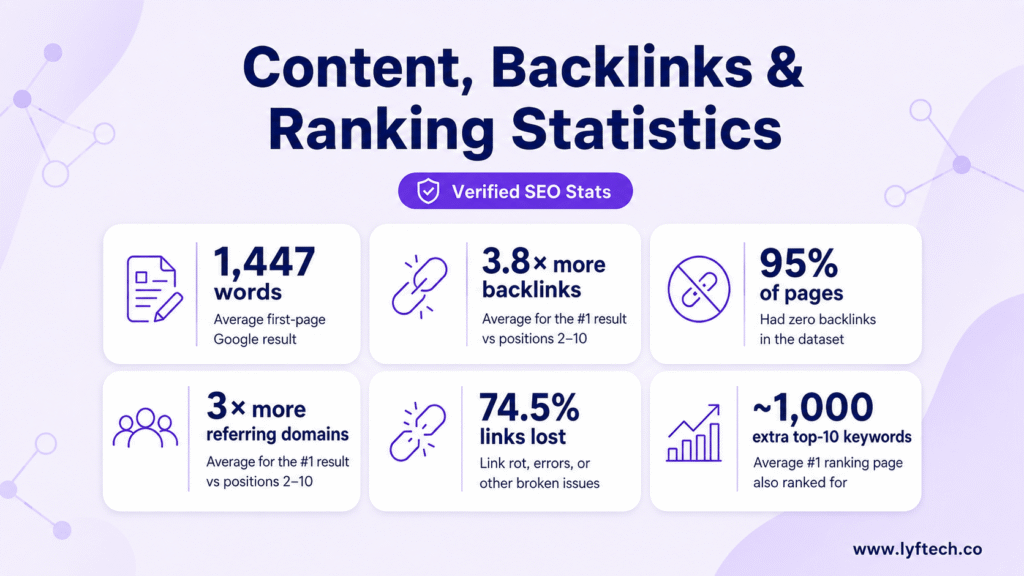
- The average first-page Google result contained 1,447 words in Backlinko’s study.
- The number-one result had 3.8 times more backlinks than results in positions two to 10, on average.
- About 95% of pages had zero backlinks in that dataset.
- The number-one page had about three times more referring domains than results in positions two to 10.
- 66.5% of links pointing to sampled websites from the prior nine years had rotted in Ahrefs’ link-rot study.
- Another 6.45% of links in that study had temporary errors.
- In total, 74.5% of the sampled links were treated as lost because of rot, temporary errors, or other issues that stopped them counting.
- The average number-one ranking page also ranked in the top 10 for nearly 1,000 additional relevant keywords in Ahrefs’ three-million-query study.
- The median number of those additional top-10 keywords was around 400.
- 30.9% of featured snippets came from the number-one organic result in Ahrefs’ older two-million-snippet study.
- 53.4% of AI citations in Ahrefs’ 2025 study went to pages under 1,000 words.
Sources: Backlinko’s ranking-factor analysis, Ahrefs’ link-rot study, Ahrefs’ keyword-overlap study, Ahrefs’ featured-snippet study, and Ahrefs’ AI-citation length study.
Do longer pages and more links automatically win?
No.
These studies show correlation, not a formula you can copy. A 500-word page can be the best result if it completes the searcher’s task. A 4,000-word guide can be weak if it repeats basic ideas and avoids the actual question.
The same applies to backlinks. Relevant editorial mentions and legitimate recommendations can support a strong page. Buying bulk, low-quality links is not a real authority strategy.
My rule is simple: make the page useful enough to deserve a recommendation, then make sure people and search engines can actually find it. Use the technical SEO guide to work through the visibility side of that process.
Keywords, Title Tags and Meta Description Statistics
- 7.4% of top-ranking pages did not have a title tag in Ahrefs’ dataset.
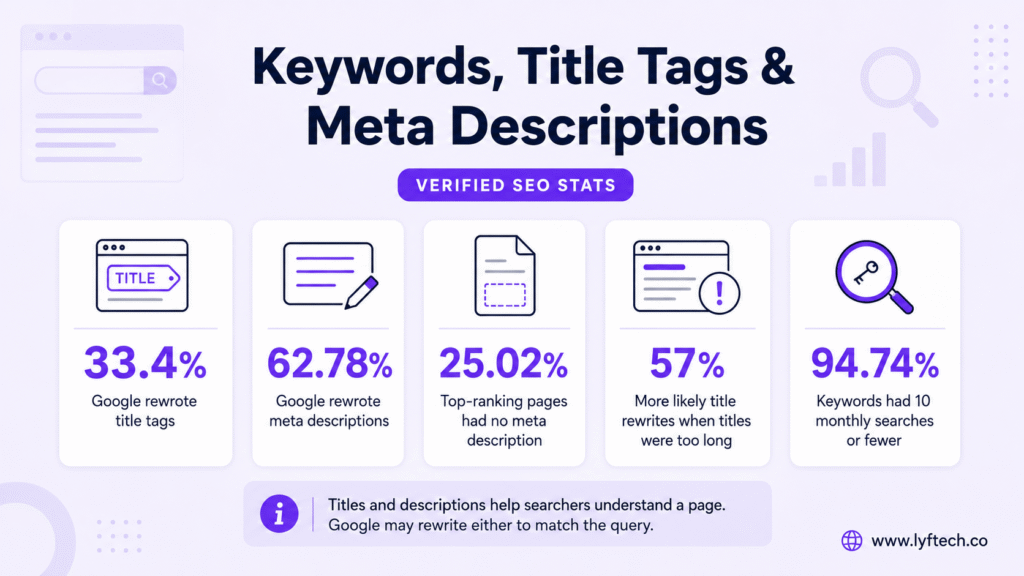
- Google rewrote title tags 33.4% of the time in Ahrefs’ analysis.
- Google was 57% more likely to rewrite titles that were too long.
- When Google ignored a title tag, it used the H1 50.76% of the time in that study.
- 25.02% of top-ranking pages did not have a meta description.
- Google rewrote meta descriptions 62.78% of the time in Ahrefs’ analysis.
- Google showed the page’s supplied meta description only 37.22% of the time in that dataset.
- 40.61% of pages had meta descriptions that were truncated.
- 94.74% of keywords had 10 monthly searches or fewer in Ahrefs’ keyword database study.
- Only 0.0008% of keywords had more than 100,000 monthly searches.
- 91.45% of Google Keyword Planner volumes were overestimates in Ahrefs’ study.
- 46.08% of clicks in Google Search Console were attributed to hidden terms in Ahrefs’ analysis.
- Ahrefs found no correlation between Flesch Reading Ease scores and ranking position.
Sources: Ahrefs’ 2026 SEO statistics roundup and Ahrefs’ on-page SEO guide.
The practical lesson for metadata and keywords
Use keywords to understand demand and language. Do not let a keyword tool decide your whole strategy.
One strong page can rank for many related searches because it answers a topic properly. That is why I group keywords by meaning and intent before I decide whether they deserve one page or separate pages.
Write a clear title tag and meta description because they help set expectations and may influence clicks. But do not panic when Google rewrites them. Google may use another part of the page when it thinks that text better matches the query.
Technical SEO Statistics
The next figures come from Ahrefs’ website-audit research. They are particularly useful because they show how often basic technical problems appear across real sites. They are not proof that every issue will affect every website equally.
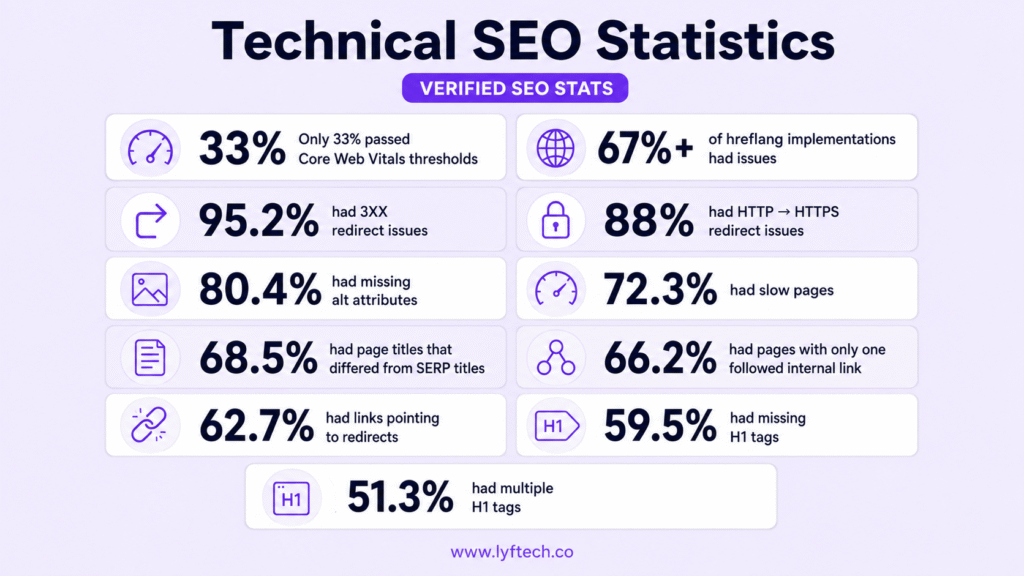
- Only 33% of websites passed Core Web Vitals thresholds in Ahrefs’ research.
- More than 67% of domains using hreflang had issues.
- 95.2% of sites had 3XX redirect issues.
- 88% of sites had HTTP-to-HTTPS redirect issues.
- 80.4% of sites had missing alt attributes.
- 72.3% of sites had slow pages.
- 68.5% of sites had page titles that did not match their SERP titles.
- 66.2% of sites had a page with only one followed incoming internal link.
- 62.7% of sites had links pointing to redirects.
- 59.5% of sites had missing H1 tags.
- 51.3% of sites had multiple H1 tags.
- Google uses the mobile version of a page for indexing and ranking under mobile-first indexing.
- Google says good Core Web Vitals alone do not guarantee top rankings.
- Google says structured data can make a page eligible for rich results, but it does not guarantee a rich-result appearance.
- Google says the structured data must match the visible page content.
- Google says there are no special technical requirements to appear in AI Overviews or AI Mode beyond the usual Search requirements.
- Google warns that generating many pages with AI without adding value for people may violate its scaled-content-abuse policy.
- Google says its systems use the mobile version of content, crawled with a smartphone agent, for indexing.
Sources: Ahrefs’ SEO statistics roundup, Google’s page-experience documentation, Google’s structured-data introduction, Google’s AI features guidance, Google’s generative-AI content guidance, and Google’s mobile-first indexing guidance.
What I would prioritise first
Do not start with an audit score.
Start with the pages that matter to revenue or lead generation. Check whether they can be crawled and indexed, whether they have the right canonical URL, whether their internal links point to the preferred page, and whether a real person can use them on a phone.
Then fix obvious friction: redirect chains, broken internal links, wasted image weight, poor navigation, slow templates, and forms that fail to submit. You do not need to chase every warning in a tool. You need to fix the issues that affect important pages, search understanding, and the visitor journey.
Local SEO and Review Statistics
For local businesses, ranking is only part of the decision. A person may find you in Search or Maps, then judge your reviews, rating, recent customer experience, and response quality before calling or booking.
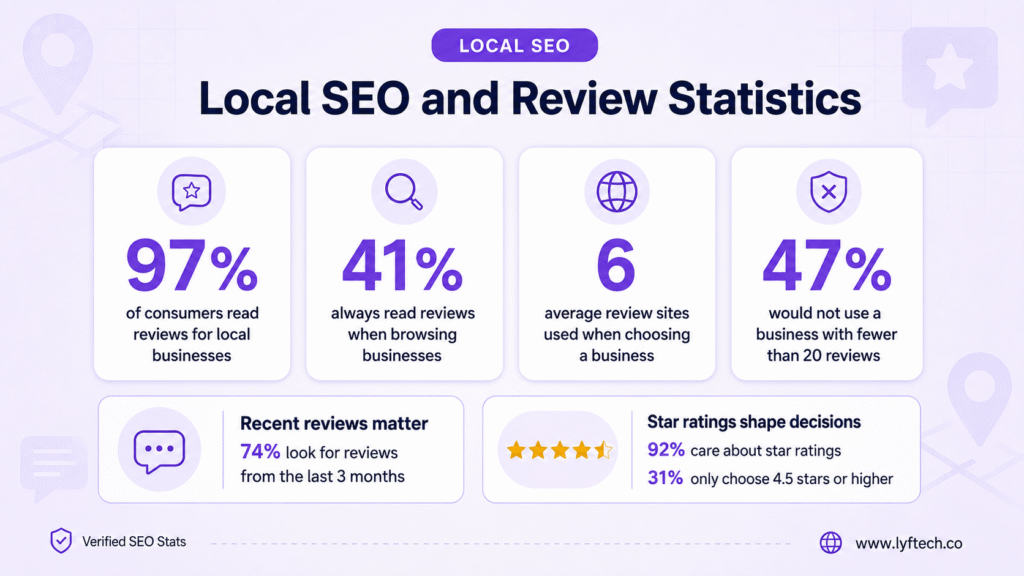
- 97% of consumers read reviews for local businesses in BrightLocal’s 2026 survey.
- 41% said they always read reviews when browsing businesses.
- The average consumer used six different review sites when choosing a business.
- 47% would not use a business with fewer than 20 reviews.
- Only 9% were willing to use a business with five reviews or fewer.
- 74% looked for reviews written in the last three months.
- 18% were only swayed by reviews from the last week.
- 32% looked for reviews written in the last two weeks.
- 92% cared about star ratings when choosing a business.
- 31% would only use a business with a rating of 4.5 stars or higher.
- 68% would only use a business with four or more stars.
- 10% said they would only use a business with a perfect five-star rating.
- Use of AI tools for local-business recommendations rose from 6% in 2025 to 45% in 2026 in BrightLocal’s research.
- Google-review use fell from 83% in 2025 to 71% in 2026 in the same local-discovery research.
- In 2026, AI was the third most-used source for local-business recommendations in that survey, behind Google and Facebook.
Sources: BrightLocal’s Local Consumer Review Survey 2026 and BrightLocal’s AI and local-recommendation research.
The local SEO takeaway
Reviews are not a side task for a local business.
Ask happy customers for honest feedback at the right point in the journey. Reply to reviews with a human response. Keep your service information, hours, phone number, booking details, and location information accurate wherever customers find you.
Do not buy reviews, filter only for positive feedback, or use copy-paste replies. Those shortcuts create risk and make the business look less trustworthy.
For a practical next step, use this local SEO guide alongside your Google Business Profile and website review.
AI Search and AI Overview Statistics
AI search is one of the biggest changes in current SEO, but the data does not support a simple claim that “SEO is dead” or that an AEO trick can guarantee citations.
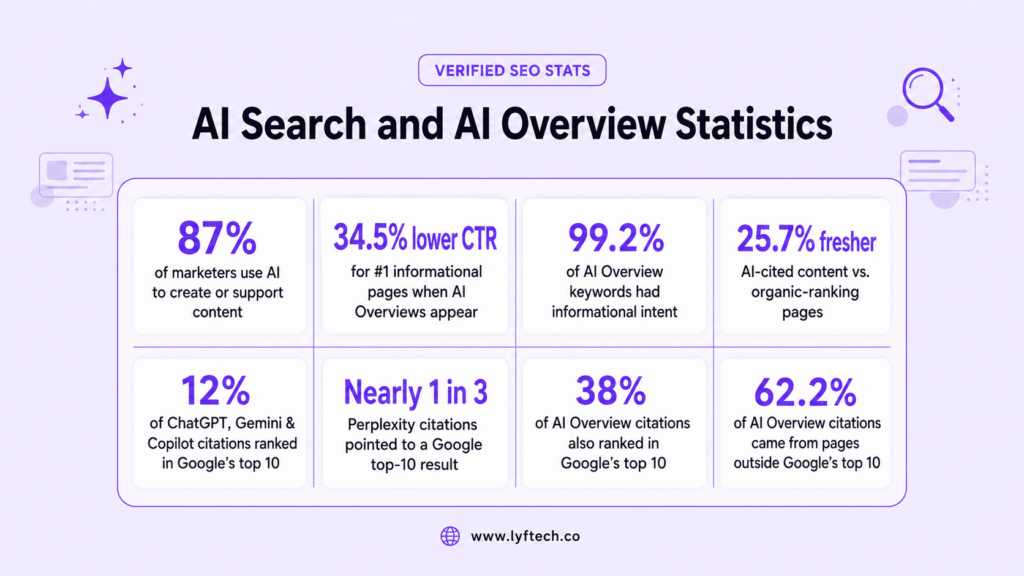
- 87% of marketers in an Ahrefs survey said they use AI to create or help create content.
- In Ahrefs’ 2025 analysis, AI Overviews were associated with a 34.5% lower average CTR for the top-ranking page on comparable informational queries.
- 99.2% of keywords that triggered AI Overviews in that study had informational intent.
- AI-cited content was 25.7% fresher on average than pages ranking in organic Google results in Ahrefs’ 2026 data.
- Only 12% of URLs cited by ChatGPT, Gemini, and Copilot ranked in Google’s top 10 for the same prompt, on average, in Ahrefs’ 15,000-prompt study.
- Perplexity was the outlier: nearly one in three of its citations pointed to a page ranking in Google’s top 10 for the target query.
- 38% of pages cited in AI Overviews also ranked in the top 10 for the same query in Ahrefs’ 2026 analysis.
- 31.2% of AI Overview citations came from pages ranking between positions 11 and 100 in one part of that study.
- 31.0% of AI Overview citations came from pages beyond the top 100 blocks in that same analysis.
- 18.2% of non-ranking AI Overview citations were YouTube URLs.
- Those YouTube URLs made up 5.6% of all AI Overview URLs cited in the dataset.
Sources: Ahrefs’ AI Overview CTR study, Ahrefs’ 2026 SEO statistics roundup, Ahrefs’ AI-search overlap study, and Ahrefs’ AI Overview citation study.
What should you do with AI-search data?
Keep the fundamentals strong.
Give the page a specific purpose. Answer the question clearly. Add information that comes from real experience, original research, products, services, or a useful point of view. Keep important content crawlable and easy to scan. Use accurate structured data where it applies.
Do not turn every paragraph into a rigid “answer block” or publish hundreds of AI-written pages with no new value. Google’s own guidance is clear: standard SEO best practices remain relevant for AI features, and there are no extra requirements for inclusion in AI Overviews or AI Mode. Read Google’s guidance on AI features and websites.
What These SEO Statistics Mean for Your Business
When I put these numbers together, five priorities become clear.
1. Build pages around genuine search intent
Before creating a page, look at the current results. Are searchers looking for a guide, a product category, a service, a comparison, a calculator, or a local provider?
Then make your page complete that job better than the alternatives. This is more useful than copying competitor headings or forcing one keyword into every paragraph.
2. Improve close-to-winning pages before chasing everything new
Pages sitting on page one or early page two may already have demand and relevance. Review what is missing: the right proof, current information, a clearer answer, stronger title, better internal links, supporting visuals, or a more direct CTA.
3. Treat technical SEO as part of the customer experience
Technical work is not just for crawlers.
If a page is slow, redirects unnecessarily, hides important content on mobile, or sends leads into a broken form, it affects real people too. That is why a useful technical review connects crawlability, page experience, and conversions.
4. Make local trust visible
Local businesses should make it easy to verify who they are, what they offer, where they serve, and why customers trust them.
Keep reviews current. Respond professionally. Show useful proof on your service pages instead of relying on vague claims.
5. Use AI as a research and production assistant, not a substitute for judgment
AI can help organise information, find content gaps, draft outlines, and speed up routine work. It cannot replace the insight you get from customer calls, campaign data, product knowledge, hands-on testing, or honest expert judgment.
That human contribution is what stops a page from becoming another generic answer in a crowded search result.
Frequently Asked Questions
Are these SEO statistics verified?
Yes. I checked the publisher pages behind the figures and linked to them throughout this article. Several statistics come from Ahrefs, Backlinko, BrightLocal, StatCounter, and official Google documentation. Some studies are older because there is no newer published dataset for the same metric, so I have described them as study results rather than fixed SEO rules.
What is the most important SEO statistic in this guide?
For me, it is the finding that 96.55% of pages in Ahrefs’ index received no organic Google traffic. It shows why a random publishing schedule rarely works. A page needs real demand, the correct intent, a useful answer, and support from the rest of the website.
Does AI search replace SEO?
No. AI search is changing how people find answers and businesses, especially for informational and local queries. But Google says the same SEO foundations still apply for its AI search features. Strong content, clear structure, crawlability, real experience, and trust still matter.
Are backlinks still important for SEO?
Relevant, earned backlinks can still support visibility, especially in competitive search results. But link counts are not a substitute for a useful page, strong website structure, or a credible business. Focus on earning mentions that make sense for your audience and industry.
Does a higher Core Web Vitals score guarantee better rankings?
No. Google says Core Web Vitals are used by its ranking systems, but good scores do not guarantee top rankings. They are part of a wider page experience and should be improved alongside content quality, search intent, and technical accessibility.
How should a small business use these statistics?
Do not try to act on all 95 at once. Start with the pages closest to revenue: your main services, product categories, local pages, and conversion paths. Check whether they match search intent, work on mobile, show proof, and have clear internal links and calls to action.
Summary
The biggest mistake I see is treating SEO statistics as trivia.
They are strategy signals.
Google still matters. High rankings still matter. Technical gaps still matter. Reviews still matter. AI search matters too, but it has not removed the need for useful pages and a trustworthy website.
If you want help turning these insights into a focused plan, request a free SEO audit. I will review the pages and website issues most likely to affect your visibility, trust, and enquiries, then show you what deserves attention first.
Written by Muhammad Daniyal, SEO & Content Strategist and Founder of Lyf Tech.
Last reviewed: August 2026.
