
Google Ads can put your business in front of potential customers quickly.
SEO can build visibility that keeps bringing people to your website after the initial work is done.
That is the main difference.
If you need qualified leads this month, Google Ads may be the right starting point. If you want to reduce dependence on paid clicks and build a stronger search presence over time, SEO deserves serious investment.
In my experience, the best choice is rarely “SEO or Google Ads forever.” It is deciding what each channel needs to do for the business right now.
A new business may need Ads to generate early enquiries while SEO foundations are being built. An established business with costly paid clicks may need SEO to create a more sustainable source of relevant traffic.
Let me break it down properly.
The Quick Answer
SEO is generally better for long-term business growth because the pages, content, authority, and organic visibility you build can continue producing results over time.
Google Ads is generally better when you need fast visibility, want to test demand, or have a time-sensitive offer.
Neither channel is automatically profitable.
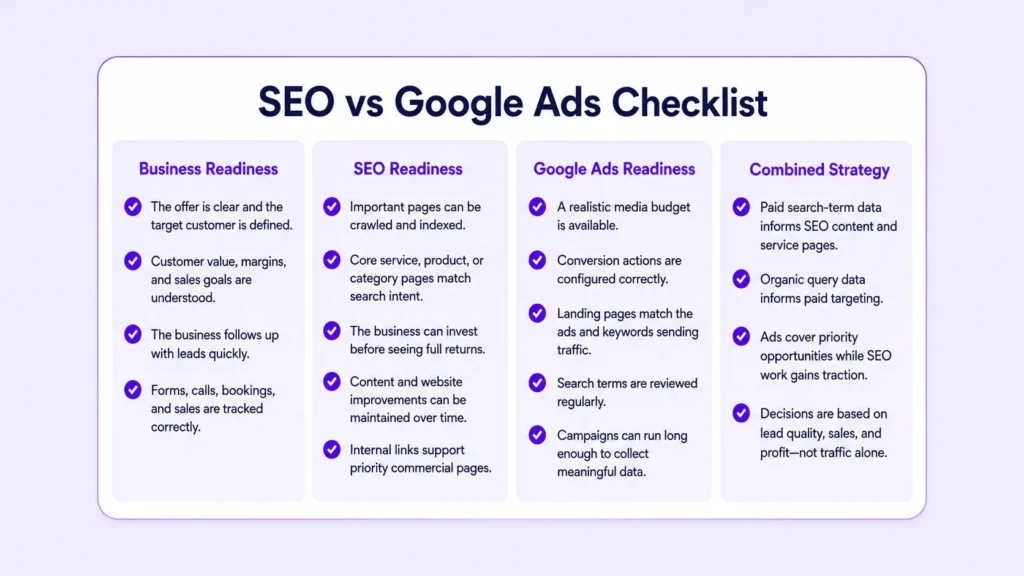
Both need:
- A clear offer
- A website that builds trust
- Landing pages that match search intent
- Working forms, calls, checkout, or booking paths
- Reliable conversion tracking
- A team that follows up with leads properly
More traffic will not fix a weak offer or a website that does not convert.
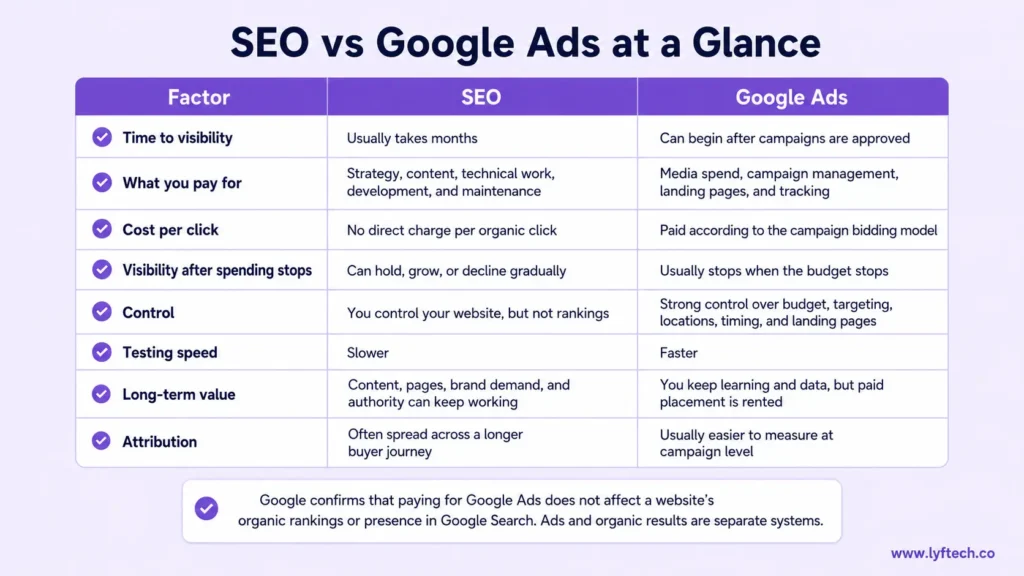
SEO Builds Assets, Google Ads Rents Attention
SEO is not “free traffic.”
You do not pay Google each time someone clicks an organic result, but real SEO still requires investment. Someone needs to research search demand, improve the site, create useful content, fix technical issues, build internal links, review performance, and maintain important pages.
The difference is where the value sits.
With SEO, you are building assets on your own website:
- Service pages
- Product and category pages
- Helpful guides
- Comparison content
- Case studies
- Topic clusters
- Internal-linking paths
- Brand visibility
With Google Ads, you pay to enter an auction and show up for relevant searches. You keep the landing pages, customer data, and campaign learnings. But the paid placement itself ends when the budget ends.
That is why I see SEO as a long-term business asset and Google Ads as a direct demand-generation channel.
Both matter. They just solve different problems.
SEO Takes Longer, Especially for New Websites
A brand-new website starts from zero.
It may have no ranking history, no meaningful content, no backlinks, no proven commercial pages, and no data showing which searches bring qualified leads. That is why I never promise that SEO will produce results in a fixed number of days.
I have worked on a new-business website that had no existing organic traffic at all. There was no old visibility to improve. We had to build the basic structure, create pages around real customer questions, improve commercial pages, and give search engines time to crawl and understand the site.
The early months were slow.
But once the site started gaining traction, the difference became clear. Instead of relying on one campaign or one landing page, it began appearing for multiple related searches across the buyer journey.
That is when SEO starts to compound.
One useful page can rank for many related queries. A well-planned content cluster can support a service page. Strong internal links can help visitors and search engines find the pages that matter.
SEO does not become maintenance-free. Competitors improve, pages become outdated, and search results change. But the work you did last year can still support this year’s leads and revenue.
For a more detailed timeline, read my guide on how long SEO takes for businesses.
Google Ads Gives You Fast, Controlled Visibility
Google Ads can begin generating impressions and clicks soon after the account, campaign, ads, billing, and targeting are set up correctly.
That makes it useful when you need to:
- Generate leads quickly
- Promote a time-sensitive offer
- Launch a new product or service
- Test a new market
- Test search demand before investing heavily in SEO
- Fill a short-term pipeline gap
However, quick traffic does not mean automatic results.
I have seen campaigns receive plenty of clicks but produce weak lead quality because the keywords were too broad, the offer was unclear, the page did not answer the searcher’s question, or the business was slow to follow up.
Google Ads gets traffic to the website faster.
It does not fix what happens after the click.
SEO vs Google Ads Cost
The real difference is the shape of the cost.
SEO is often more front-loaded. You invest in research, technical work, content, page improvements, and ongoing maintenance before the full return becomes visible.
Google Ads is more immediate. You can connect spending and clicks more directly, but traffic usually depends on continued media spend.
| Cost area | SEO | Google Ads |
| Initial work | Research, audit, technical fixes, priority pages, content planning | Account setup, tracking, keyword research, ads, landing pages |
| Ongoing cost | Content updates, new pages, links, technical maintenance, reporting | Media budget, bid management, testing, creative, reporting |
| Cost when traffic grows | Usually does not rise for every extra organic click | Often rises as you scale spend or enter more competitive auctions |
| Risk | Investing before returns are clear | Paying for traffic that does not turn into qualified leads |
SEO can become more cost-efficient over time.
Google Ads can produce quicker evidence.
Neither is cheap when it is managed properly.
Both Channels Can Reach High-Intent Customers
A common mistake is thinking SEO is only for awareness while Google Ads is only for sales.
Both can reach people ready to buy.
The difference is how you reach them.
With SEO, you need the right page for the right search intent.
| Search query | Best SEO page type |
| What is local SEO? | Educational guide |
| Local SEO checklist | Checklist or practical guide |
| Local SEO services | Service page |
| Best local SEO agency | Comparison or commercial page |
| Local SEO agency in Lahore | Local landing page |
One page should not try to do every job.
I have seen businesses put a definition, service pitch, pricing section, generic blog content, local targeting, and FAQs on one page—then wonder why it does not rank or convert well.
The better approach is to create intent-specific pages and connect them naturally.
With Google Ads, you can choose keywords, locations, devices, schedules, audiences, and landing pages. But you still need to review the actual search terms that trigger your ads.
I have seen accounts waste budget on irrelevant searches simply because nobody checked the search terms report or added negative keywords for months.
That is not an Ads limitation. It is poor campaign management.
SEO vs Google Ads Control
Google Ads gives you more immediate control.
You can change your budget, pause campaigns, adjust locations, exclude search terms, test landing pages, or stop spending within minutes.
SEO gives you control over your own website:
- Content
- Page structure
- Internal links
- Technical setup
- Publishing
- User experience
- Conversion paths
But you cannot control exactly when Google will rank a page, how high it will rank, or whether a competitor will outperform you next month.
Google also makes it clear that it does not guarantee crawling, indexing, or ranking for every page. That is why responsible SEO should never come with guaranteed rankings. Google’s guidance for hiring an SEO makes the same point.
Google Ads Is Better for Fast Testing
This is one of the strongest reasons to use Google Ads alongside SEO.
A well-managed campaign can help you test:
- Whether people search for a service
- Which messages earn clicks
- Which locations respond best
- Which offers create enquiries
- Whether your landing page converts
- Whether leads are actually qualified
The data is useful, but it is not a perfect prediction of SEO performance.
Paid and organic results can look different. Ad positions, search-result features, user behaviour, and click patterns can all affect the outcome.
Still, Ads can help you avoid investing months into a topic, offer, or landing page without any early market feedback.
SEO Is Better for Building Search Coverage
SEO gives you the chance to build coverage across a whole topic, not just the keywords you bid on today.
For example, an SEO agency might build pages around:
- SEO services
- Technical SEO
- Local SEO
- SEO audits
- SEO content writing
- SEO pricing
- SEO vs Google Ads
- How long SEO takes
- SEO case studies
- SEO checklists
Each page can serve a different customer question. Together, they make the site more helpful, better connected, and more relevant to the wider topic.
One genuinely useful guide may reach dozens or hundreds of related searches over time.
But publishing more content without a plan creates problems too.
I have cleaned up websites that published hundreds of posts with no clear purpose, overlapping topics, thin articles, and little internal-link support. More pages do not automatically mean more traffic.
A better system is to build pages around real search demand, business relevance, and a clear internal-linking structure.
Read my guide on topical authority to understand how this works in practice.
Which Channel Is Easier to Measure?
Google Ads is usually easier to measure at campaign level.
You can connect spend, clicks, conversion actions, cost per lead, and cost per acquisition more directly.
But Ads attribution is not perfect. People can switch devices, call instead of submit a form, research for weeks, or become customers offline.
SEO attribution is often harder because organic search commonly begins a longer journey.
For example, someone may:
- Find an informational guide through Google.
- Leave without converting.
- Return later by searching your brand name.
- Read a case study or service page.
- Submit an enquiry days later.
A last-click report may give all the credit to the final visit and miss the page that introduced the person to your business.
That is why I do not judge SEO only by last-click conversions.
For SEO, I look at:
- Non-brand clicks
- Organic visibility for priority pages
- Organic leads and revenue
- Assisted conversions
- Branded search growth
- Qualified enquiries
- Reduced dependence on paid search over time
For Google Ads, I look at:
- Spend
- Cost per lead
- Cost per acquisition
- Conversion rate
- Search-term quality
- Lead quality
- Revenue or return on ad spend
Then I compare both channels against the business metrics that matter: qualified leads, sales, profit, and customer lifetime value.
A cheap lead that never becomes a customer is not a win.
Conversion Rate Matters More
Both SEO and Ads can be blamed for problems that actually sit on the website.
Common examples include:
- An unclear offer
- Slow or confusing landing pages
- Weak calls to action
- No testimonials or proof
- Forms that do not work properly
- No clear pricing context
- Weak follow-up process
- Poor mobile experience
- Tracking that misses calls or form submissions
Google Ads often exposes these issues quickly because paid traffic arrives fast.
SEO can hide the same issue for longer because organic traffic may build gradually.
Before increasing SEO or Ads spend, I recommend checking the full conversion path yourself:
- Submit the form
- Call the phone number
- Test the booking flow
- Check confirmation emails
- Test it on mobile
- Confirm that conversion tracking records the action correctly
More traffic only makes a broken system more expensive.
What Happens When You Stop Paying?
This is where the difference between the channels becomes obvious.
If you pause Google Ads, your paid visibility usually stops almost immediately.
You keep the campaign data, landing pages, and customer insights. But the traffic from paid placements ends with the spend.
If you pause SEO work, organic performance does not usually disappear overnight.
It may hold for a while. It may decline gradually as competitors improve, content becomes outdated, or technical issues develop. It may also grow if strong pages continue earning links and satisfying searchers.
SEO has more residual value.
Google Ads has more immediate control.
Both statements are true.
When SEO Is the Better Choice
SEO is usually the stronger first investment when:
- Your business is built for long-term growth
- People search for your service or product consistently
- Paid clicks are expensive in your market
- You can wait for returns to build
- You have expertise that can become useful content
- You need a stronger website foundation
- You want to reduce paid-search dependence over time
SEO is especially valuable for service businesses, ecommerce brands, SaaS companies, publishers, and local businesses with ongoing search demand.
When Google Ads Is the Better Choice
Google Ads is usually the stronger first move when:
- You need leads or sales quickly
- You are launching a new service or product
- You have a limited-time offer
- You need to test a new market
- You can measure conversions reliably
- Your customer value supports the cost of acquisition
- You have a landing page built for the campaign
Ads can also be useful when organic results are dominated by large, established competitors and the business needs visibility while its SEO work gains momentum.
When You Should Use SEO and Google Ads Together
For most businesses, the right answer is both.
Here is the approach I recommend.
Use Ads While SEO Is Building
A new website may need months to gain meaningful organic visibility. Google Ads can bring in relevant visitors during that period, while SEO work builds the pages, structure, content, and trust signals needed for long-term growth.
Use Paid Data to Improve SEO Decisions
Search-term data can reveal how people describe their problems, which services they look for, and which messages create action. Use that insight to improve priority service pages, FAQs, content briefs, and future SEO topics.
Use SEO to Improve Paid Landing Pages
SEO forces you to think clearly about search intent, page purpose, headings, proof, internal links, and user journeys. Those same improvements can make paid landing pages more useful and more likely to convert.
Google Ads itself treats landing-page experience as one component of its Quality Score diagnostic. Google explains that ad relevance and landing-page usefulness matter.
Let Content Support Visitors Who Are Not Ready Yet
Many people do not convert on the first visit. A useful guide, comparison article, FAQ, case study, or pricing page can help them research your business and return when they are ready. That is where SEO content can support paid traffic beyond the first click.
Reduce Paid Dependence Over Time
The goal is not always to turn Ads off. Instead, use SEO to reduce your reliance on paying for every important visit. Then use paid budget more selectively for launches, new markets, high-value terms, remarketing, and offers that need immediate attention.
Frequently Asked Questions
Is SEO better than Google Ads?
SEO is generally better for long-term visibility and website value. Google Ads is generally better for immediate, controlled visibility. The right choice depends on your timeline, budget, margins, competition, and website condition.
Is SEO cheaper than Google Ads?
Not necessarily at the start. SEO requires investment in strategy, content, technical work, and maintenance. It can become more cost-efficient over time because pages may continue attracting organic traffic without a charge for every click.
How long does SEO take compared to Google Ads?
Google Ads can begin producing impressions and clicks after campaigns launch. SEO usually takes months, and new websites often need longer because they are building their search presence from the ground up.
Should a new business start with SEO or Google Ads?
Most new businesses benefit from using both. Google Ads can help create early demand and test offers, while SEO builds the long-term foundation that reduces dependence on paid traffic later.
Can SEO replace Google Ads completely?
SEO can reduce the need to pay for certain searches, but it does not replace Ads in every situation. Paid campaigns are still useful for launches, promotions, new markets, and time-sensitive offers.
Does running Google Ads improve organic rankings?
No. Google says that advertising does not influence organic search ranking or inclusion. Ads can still provide useful search and landing-page insights that help inform SEO decisions.
Which channel is easier to measure?
Google Ads is usually easier to measure at campaign level. SEO often supports longer, multi-touch journeys, so measuring assisted conversions and business-level outcomes is important.
My Honest Take
Google Ads turns visibility on.
SEO builds the website, content, and search presence that can keep creating opportunities long after the first campaign is paused.
If you need demand today, use Ads.
If you want to build a stronger long-term growth channel, invest in SEO.
If you need both immediate leads and a better future position, run both with a clear role for each channel.
If you are unsure whether your website is ready for SEO, Google Ads, or a combined approach, request a free SEO audit. I will review the website foundation, priority pages, search opportunity, and conversion path, then show you what deserves attention first.
Written by Muhammad Daniyal, SEO & Content Strategist and Founder of Lyf Tech.
