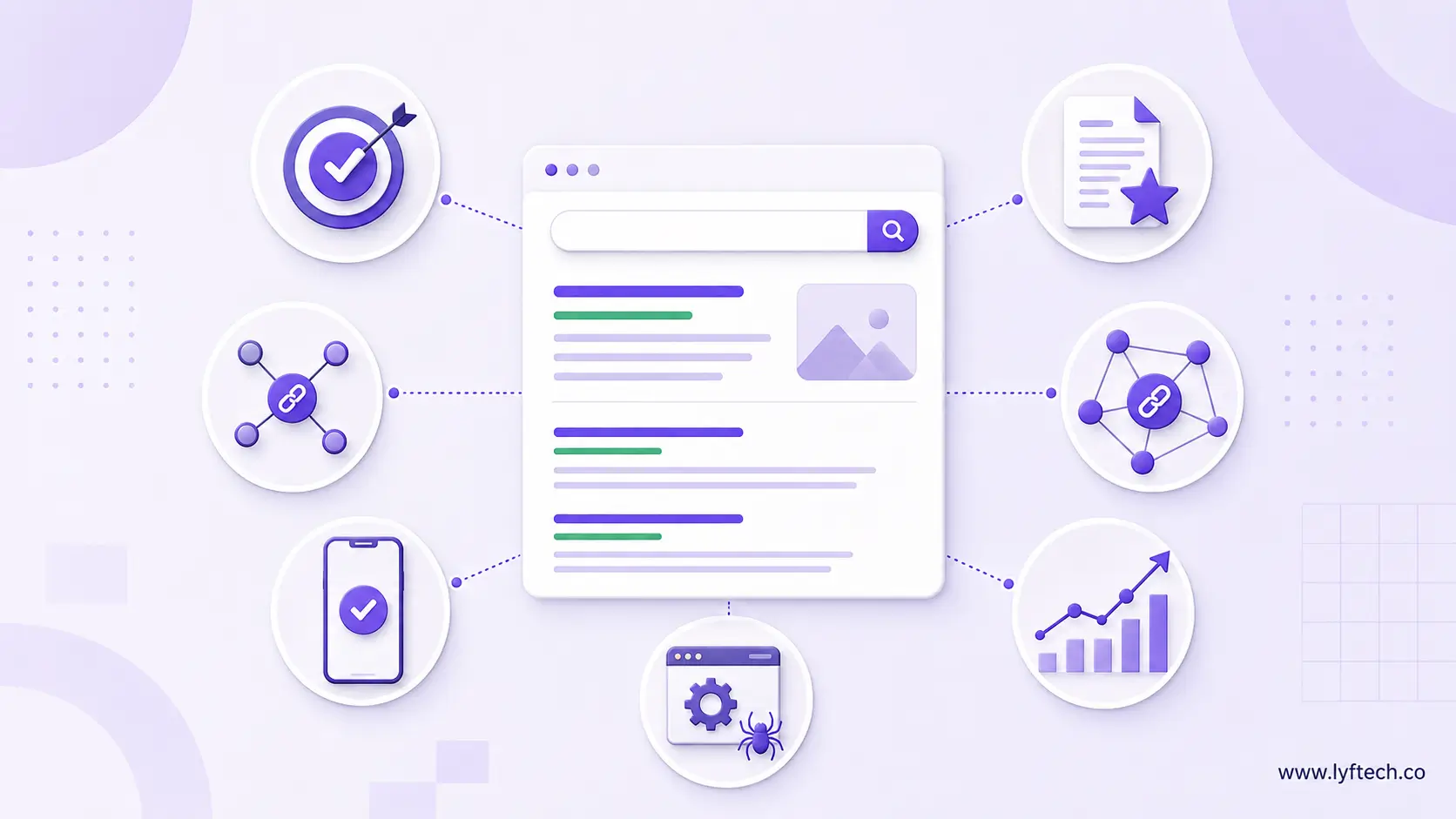
Google does not publish a fixed list of “the top 25 SEO ranking factors” or tell us the exact weight of each signal.
Its ranking systems use many signals to understand individual pages, while site-wide signals also help it understand a website overall. The goal is to show the most relevant, useful, and reliable result for a search.
So, when I talk about SEO ranking factors, I do not mean a checklist of tricks.
I mean the areas that consistently decide whether a page has a realistic chance of ranking:
- Does the page answer the searcher’s actual need?
- Is it useful, original, and trustworthy?
- Can Google crawl, index, and understand it?
- Does the site support it with clear structure and relevant links?
- Is the page easy to use?
In my experience, most SEO problems do not come from one missing “ranking factor.”
They come from weak foundations: the wrong page for the keyword, thin content, poor internal links, unclear site structure, weak trust signals, or technical errors that stop Google from properly accessing the page.
Let’s break down the SEO factors that matter most.
1. Helpful, People-First Content
Helpful content is the foundation of SEO.
Google says its systems are designed to prioritize helpful, reliable information created to benefit people—not content created mainly to manipulate rankings. It also asks whether your content adds original information, analysis, research, or value beyond what is already ranking.
Before publishing a page, ask:
- Does it solve a real problem?
- Does it answer the main question early?
- Does it offer useful advice, examples, proof, or insight?
- Is it better than a generic rewrite of existing articles?
If the answer is no, adding more keywords or backlinks will not fully solve the problem.
2. Search Intent Match
A page needs to match what the searcher wants.
This is one of the biggest reasons pages fail to rank.
For example, someone searching “what is technical SEO” likely wants an educational guide. Someone searching “technical SEO services” is looking for a service provider. Someone searching “technical SEO audit checklist” may want a practical resource they can use immediately.
These are different intents. They need different pages.
Before creating or improving a page, search the target keyword and study the results:
- Are they guides, product pages, category pages, tools, videos, or service pages?
- Are people looking for a quick answer or a detailed guide?
- Do the top pages focus on beginners, business owners, or experts?
- What questions do they answer?
A strong page gives the searcher what they came for.
3. Relevance to the Query
Google needs to understand what your page is about.
That does not mean repeating the same keyword 20 times.
It means making the topic clear through your title, headings, introduction, body copy, examples, internal links, images, and supporting terms.
If your page targets “local SEO services,” it should naturally discuss relevant concepts such as:
- Google Business Profile
- Local rankings
- Maps visibility
- Service areas
- Local citations
- Reviews
- Location pages
- Local search intent
The goal is topic clarity, not keyword stuffing.
4. Original Information and First-Hand Experience
Generic content is easier than ever to create.
That also means generic content is easier than ever to ignore.
Google encourages creators to add original information, research, analysis, and first-hand expertise. This matters even more when you are writing about services, products, health, money, software, or major business decisions.
Useful ways to add originality include:
- Your own client lessons
- Screenshots or examples
- Original data
- Tested processes
- Before-and-after observations
- Expert opinions
- Clear explanations of trade-offs
- Common mistakes you have seen in real work
For Lyf Tech content, I do not want articles that simply explain what other SEO blogs already said.
I want them to help a business owner make a better decision.
5. Trust and E-E-A-T Signals
E-E-A-T stands for experience, expertise, authoritativeness, and trustworthiness.
Google states that E-E-A-T is not one single ranking factor with a visible score. However, its systems use multiple signals that help identify content that demonstrates these qualities. Trust is the most important part. This is especially important for topics that can affect a person’s health, finances, safety, or wellbeing. Google explains E-E-A-T here.
Build trust with:
- Clear author bylines
- A detailed author page
- Accurate claims
- Sources for important facts
- First-hand experience
- Transparent business information
- Clear contact details
- Privacy, editorial, and refund policies where relevant
- Honest limitations and balanced advice
Trust is not something you add with one plugin or badge.
It is built through the whole website.
6. Crawlability
Google must be able to crawl a page before it can properly understand and consider it for ranking.
Common crawlability issues include:
- Important pages blocked in robots.txt
- Broken internal links
- Pages only available through complicated JavaScript
- Orphan pages with no internal links
- Poor XML sitemap setup
- Server errors
- Slow or unstable hosting
A page can be excellent, but if Google cannot reliably access it, it will struggle to perform.
7. Indexability and Canonicalisation
Crawling and indexing are not the same thing.
Google may crawl a page but decide not to index it. Or it may index a different version of the page because of duplicate content or canonical errors.
Check that important pages:
- Do not contain a noindex tag by mistake
- Use the correct canonical URL
- Are not duplicates of another page
- Return a proper 200 status code
- Are included in relevant internal-link paths
- Are not blocked from crawling
This is why a proper SEO audit should always review index coverage, canonical tags, redirects, and duplicate URLs.
8. Internal Linking
Internal links help Google discover pages and understand how content relates across your site.
They also help users move from an informational article to a relevant service, category, product, or next step.
For example, an article about “how long SEO takes” should naturally link to:
- SEO services
- SEO audit services
- SEO strategy guidance
- SEO vs Google Ads
- Relevant case studies
In my experience, internal linking is one of the most overlooked opportunities on growing websites.
You do not always need more pages. Sometimes, you need better connections between the pages you already have.
9. Site Structure
A clean site structure makes it easier for users and search engines to understand your website.
Important pages should not be buried several clicks deep with no clear path.
A simple structure might look like this:
- Main service page
- Supporting service pages
- Relevant guides
- Case studies
- FAQs
- Contact or audit page
For content-led websites, use topic clusters. Create a main guide, then build supporting articles around related questions and connect them naturally.
Read my guide on topical authority for a deeper explanation.
10. Backlinks
Backlinks still matter.
Google confirms that its systems use links to understand what pages are about and which pages may be helpful. PageRank remains part of Google’s core ranking systems, though it has evolved significantly over time. Google’s ranking systems documentation confirms this.
However, more backlinks do not automatically mean better rankings.
A link is more useful when it comes from a website that is:
- Relevant to your topic or industry
- Trusted by real users
- Editorially selective
- Contextually related to your page
- Able to send relevant visitors
A few strong, relevant mentions can be more valuable than hundreds of low-quality links.
11. Link Quality and Relevance
Not every backlink deserves the same attention.
Low-quality link schemes, paid link spam, automated links, and irrelevant directory links can create risk rather than long-term value.
Focus on links earned through:
- Useful original content
- Digital PR
- Expert quotes
- Case studies
- Industry partnerships
- Relevant resource pages
- Real brand mentions
- Useful tools, templates, or research
12. Topical Coverage
One page rarely builds authority on its own.
If you want to rank for a competitive subject, your website should show that it understands the wider topic.
For example, an SEO agency website should not only have one generic SEO services page. It should also cover related areas such as:
- Technical SEO
- On-page SEO
- Local SEO
- Ecommerce SEO
- SEO audits
- Content strategy
- Internal linking
- Link building
- SEO reporting
- SEO timelines
This helps users find deeper answers. It also gives search engines more context around your areas of expertise.
13. A Clear Site Purpose
Google encourages website owners to have a primary purpose or focus.
A site that publishes useful, connected content around a clear subject is easier to understand and trust than one that publishes random articles across unrelated topics just to chase traffic.
Do not build content around every keyword with search volume.
Build around topics that connect to:
- Your audience
- Your expertise
- Your services or products
- Your business goals
Traffic from the wrong audience is not meaningful growth.
14. Duplicate Content Management
Duplicate or highly similar pages can weaken clarity.
If several pages target the same search intent, Google may struggle to decide which one to rank. This can lead to keyword cannibalisation, where your own pages compete against each other.
Common examples include:
- Multiple location pages with almost identical copy
- Several blog posts answering the same question
- Product variants with duplicate descriptions
- HTTP, HTTPS, www, and non-www versions of the same page
- Filtered ecommerce URLs indexed unnecessarily
Sometimes the right move is not to publish another article.
It is to combine overlapping pages into one stronger resource.
15. Title Tag Quality
Your title tag helps search engines and users understand the page.
Google may generate a different title link in search results, but that does not mean title tags no longer matter. Clear, descriptive titles still give Google strong context and improve the chance that your search listing communicates the right message. Google’s title-link guidance explains how title links are created.
A strong title tag should be:
- Accurate
- Specific
- Relevant to the page
- Clear about the benefit or topic
- Free from keyword stuffing
For example:
Weak: SEO Services | Best SEO Company | SEO Expert | SEO Agency
Better: SEO Services for Businesses That Want Qualified Leads
16. Clear Headings and Page Structure
Headings are not a magic ranking trick.
But they make content easier to read, scan, and understand.
Use headings to organise the page logically:
- One clear H1
- H2s for major sections
- H3s for supporting details
- Short paragraphs
- Lists, examples, and tables where useful
A well-structured page helps visitors find answers quickly. It also helps search engines better understand the relationships between sections.
17. Keyword Use in Important Areas
Keywords still matter, but not in the old-fashioned “hit a keyword-density target” way.
Use your primary keyword naturally in places where it helps clarify the page:
- Title tag
- H1
- URL, where appropriate
- Opening paragraph
- Relevant headings
- Image alt text, only where accurate
- Internal-link anchor text, where natural
There is no perfect keyword percentage.
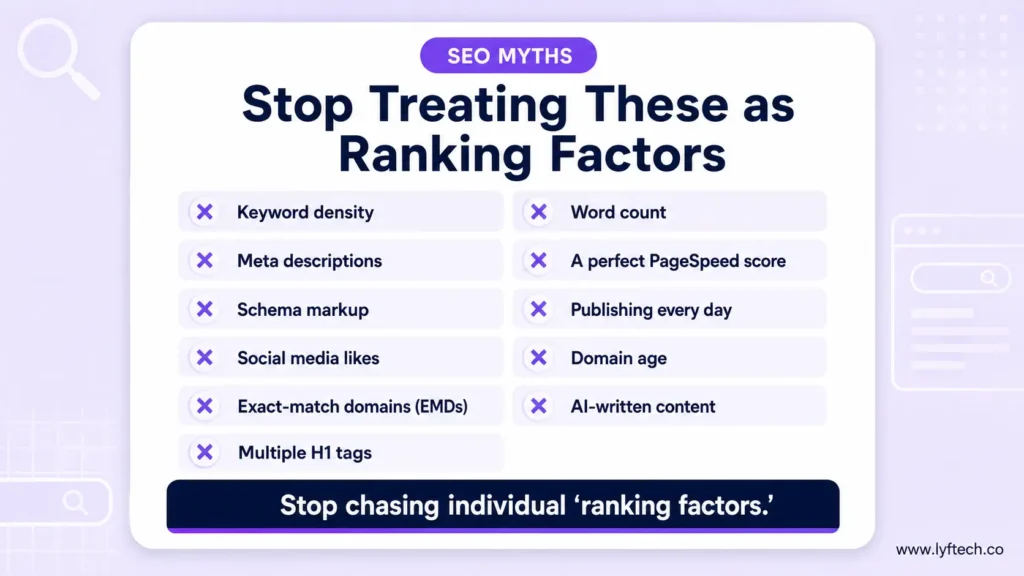
Google does not have a recommended word count or keyword-density target. Write enough to answer the query properly. Google explicitly warns against writing to a preferred word count.
18. Freshness When the Query Needs It
Not every page needs constant updates.
A guide on “what is SEO” may stay useful for a long time. A guide on SEO trends, software pricing, algorithm changes, laws, product specifications, or search statistics may need regular updates.
Google has freshness systems for searches where people expect recent information.
Update content when there is a real reason:
- Facts have changed
- The search results have changed
- The topic has developed
- Examples are outdated
- New questions have become important
- The page no longer satisfies intent
Do not change the publish date without making meaningful updates.
19. Page Experience
Page experience is part of SEO because a page that frustrates users is less useful.
Google recommends looking at the full page experience rather than obsessing over one score or one metric. This includes how quickly the page becomes usable, how stable the layout is, whether it works on mobile, and whether people can find what they need without friction. Google’s page-experience guidance covers this in more detail.
Improve page experience by:
- Reducing intrusive pop-ups
- Keeping layouts stable while loading
- Making text easy to read
- Using clear navigation
- Avoiding clutter
- Keeping forms simple
- Making buttons easy to tap
- Removing unnecessary scripts and heavy media
20. Mobile Usability
Google uses mobile-first indexing, meaning it primarily uses the mobile version of your site for indexing and ranking.
Your mobile version should not be a stripped-down afterthought.
Check that mobile visitors can:
- Read content without zooming
- Use menus easily
- Submit forms
- Click buttons
- View important images and text
- Access the same essential content as desktop users
A page that looks good on a large desktop screen can still fail badly on a phone.
21. Website Performance
Speed is not usually the only reason a page ranks or fails to rank.
But poor performance can make a site frustrating, especially on mobile connections. It can also hurt lead generation, ecommerce sales, and user trust.
Focus on practical improvements:
- Compress and properly size images
- Use modern image formats where suitable
- Remove unused plugins and scripts
- Improve hosting when needed
- Reduce large layout shifts
- Avoid loading heavy videos immediately
- Test priority templates in PageSpeed Insights
Treat speed as part of usability and conversion performance—not as a one-number SEO game.
22. Structured Data
Structured data can help Google understand certain kinds of content and make your pages eligible for enhanced search appearances, such as product results, review snippets, FAQs where supported, recipes, and breadcrumbs.
However, structured data does not guarantee a rich result or higher rankings.
Google is clear that markup helps it understand page information and determine eligibility for certain search features. Its structured-data introduction explains this.
Use a schema where it accurately represents visible page content.
Do not add misleading markup just to chase rich results.
23. Image, Video, and Content Accessibility
Search engines need context around non-text content.
Use descriptive image file names, captions where helpful, and accurate alt text. If a visual explains an important process, include enough supporting text on the page so users and search engines understand it.
For example, instead of writing generic alt text like:
SEO image
Write:
Technical SEO audit checklist showing crawlability, indexing, redirects, and internal links
Alt text should describe the image for accessibility first. Keywords should only appear when they are genuinely relevant.
24. Local Relevance for Local Searches
If you serve a local market, Google needs clear evidence of where you operate and what services you provide.
For local SEO, important signals include:
- An accurate Google Business Profile
- Consistent business name, address, and phone number
- Real reviews
- Location-specific service pages
- Clear service areas
- Local backlinks and mentions
- Relevant local content
- Accurate opening hours and contact details
A business in Lahore, Dubai, London, or Toronto should not use copied location pages with only the city name changed.
Each location page needs useful local context.
25. Consistent Quality Across the Website
Google uses page-level signals, but it also uses site-wide signals and classifiers to understand content.
That does not mean one weak page destroys an entire website.
It does mean that a website full of thin, outdated, duplicated, or low-value pages creates a weaker overall quality picture than a website with strong editorial standards and useful, focused content.
Review your site regularly for:
- Thin pages
- Outdated articles
- Duplicate content
- Broken links
- Old service information
- Orphan pages
- Weak internal links
- Poor conversion paths
- Content that no longer serves your audience
Consistency compounds over time.
SEO Ranking Factors Checklist
Before expecting a page to rank, check the fundamentals:
- The page matches the search intent.
- The main question is answered early.
- The content adds original value.
- Claims are accurate and supported where needed.
- The page is crawlable and indexable.
- The canonical URL is correct.
- The title, H1, headings, and copy clearly explain the topic.
- Relevant internal links support the page.
- The page fits into a clear topic cluster.
- The page has a useful next step or CTA.
- Mobile users can use it easily.
- Images, scripts, and layouts do not create unnecessary friction.
- The page has been checked for outdated information.
- The site provides clear trust and authorship signals.
- Performance is measured through qualified traffic, leads, sales, or revenue.
Frequently Asked Questions
What are the most important SEO ranking factors?
The most important areas are helpful content, search intent match, relevance, original value, trust, crawlability, indexability, internal links, backlinks, topical coverage, and page experience.
Google does not publish a fixed weighted list, so avoid anyone who claims to know the exact percentage value of every signal.
Are backlinks still important for SEO?
Yes. Google confirms that link analysis systems, including PageRank, remain part of its core ranking systems. However, relevant and trustworthy links matter more than large volumes of low-quality links.
Is page speed a ranking factor?
Page experience and performance matter, but speed should not be treated as the only reason pages rank. Focus on making the page fast enough and easy enough for real users to use—especially on mobile.
Does E-E-A-T directly rank pages?
E-E-A-T is not one direct ranking factor or public score. Google uses various signals to identify content that demonstrates experience, expertise, authoritativeness, and trustworthiness. Trust matters most.
Does structured data improve rankings?
Structured data does not guarantee rankings. It can help Google understand content and make a page eligible for certain enhanced search results when the markup is accurate and supported.
How many ranking factors does Google use?
Google uses many signals and systems. It does not publish a complete list or disclose the exact weighting of each factor.
Final Thoughts
The biggest SEO mistake is chasing ranking factors as isolated hacks.
That approach usually leads to keyword stuffing, unnecessary content, fake link-building, and technical changes that do not solve the real problem.
The websites that grow consistently usually do the fundamentals better:
- They create useful content for a defined audience.
- They match search intent.
- They keep their site technically accessible.
- They build clear topic clusters.
- They use internal links properly.
- They earn trust.
- They make important pages easy to use.
- They measure qualified leads and business results—not traffic alone.
If you want to find out which of these areas is holding your website back, request a free SEO audit.